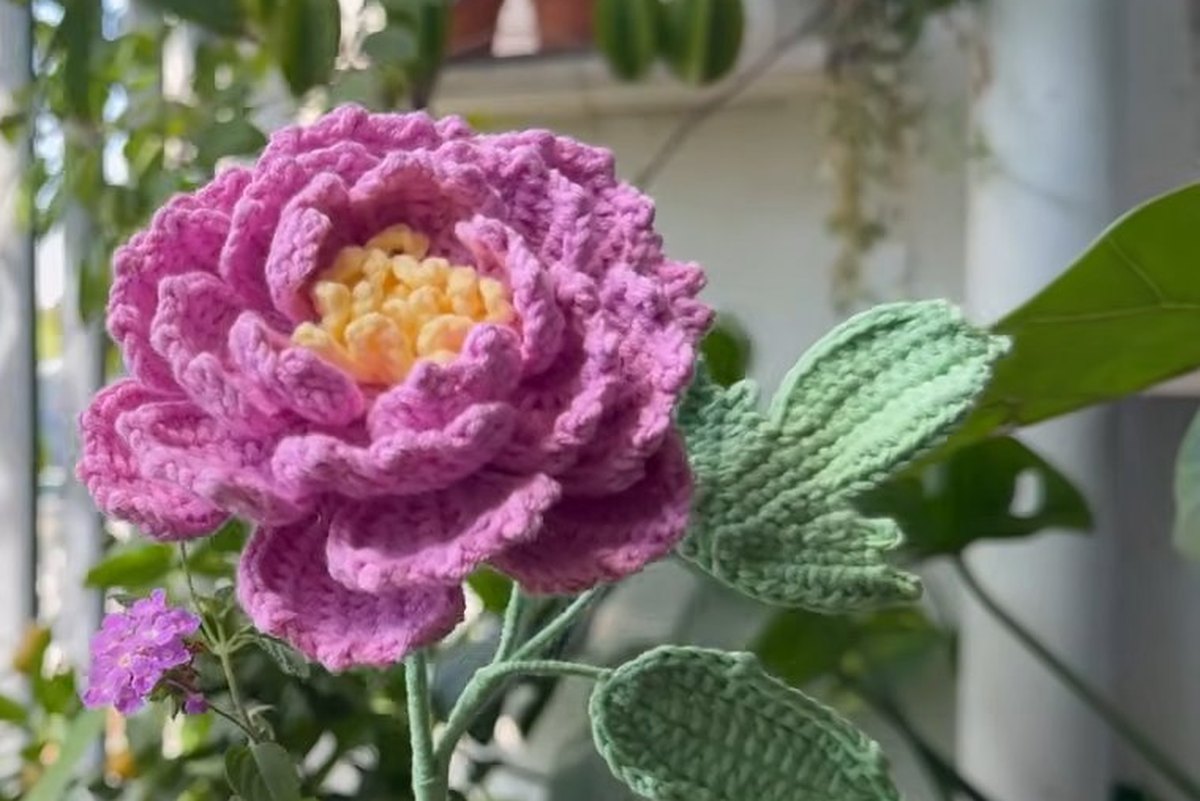
This crochet rose pattern is not worked in rounds at all. It is one flat strip, 35 chains long, with a row of fan-shaped petals along one edge, and the rose appears only when you roll that strip up and glue it. That is why it suits beginners: nothing has to be joined in a circle, and every petal is the same.

What follows is a free crochet rose pattern written out step by step from a video tutorial, with the stitch labels read off the screen and the counts checked. Each of the 16 steps has its own photo from the tutorial. You make three parts: the petal strip, a six-point green leaf, and a stem, then put them together with a glue gun. It is an easy crochet rose for a bouquet, a gift, or a vase on a shelf.
Key numbers. 35 chains in the base (stated) · 11 chain spaces along the strip (derived) · 9 double crochet per petal (stated) · 12 double crochet in the leaf ring (stated) · 6 leaf points, 2 ring stitches each (derived) · 3.00 mm hook (stated) · acrylic yarn (stated).
On this page
- What you need for this crochet rose pattern
- The crochet rose pattern at a glance
- Make the petal strip
- Make the six-point leaf
- Roll and assemble the rose
- Where this crochet rose pattern goes wrong
- Hook size and yarn for a crochet rose
- 5 more free crochet rose patterns
- Where to go next
- Crochet rose pattern FAQ
- Sources
What you need for this crochet rose pattern
The tutorial keeps the kit small. One hook works both colours, and the only non-yarn item that matters is the glue gun.
| Item | What the tutorial uses | Note |
|---|---|---|
| Yarn | Acrylic, in lavender and green | Stated. Weight and brand are not given |
| Hook | 3.00 mm | Stated, and printed on the hook shown in the video |
| Glue | Hot glue gun | Holds the rolled petals, the stem and the leaf |
| Stem | Green covered stem | Floral wire or a thin green-wrapped stick does the same job |
| Tools | Scissors, yarn needle | For cutting and weaving in ends |
| Finished size | Not stated | Measure your own rose after rolling |
The tutorial gives no finished diameter and no yardage, so this page gives neither. What it does fix is the stitch counts, and those are enough to plan: one base chain of 35, one fan of 9 double crochet per chain space, and a 12-stitch leaf ring.
Stitches and abbreviations
Crochet has two naming conventions for the same stitches, and this crochet rose pattern gives both names. The main names match the labels in the tutorial. If you learned the other convention, shift each name by one step.
| Name used here | Abbreviation | Other convention | Used in |
|---|---|---|---|
| Chain | ch | Chain | Base chain, leaf ring, leaf points |
| Slip stitch | sl st | Slip stitch | Joining the ring, closing each leaf point |
| Single crochet | sc | Double crochet (dc) | Anchoring petals, working across each fan |
| Double crochet | dc | Treble (tr) | V-stitches, petal fans, leaf ring |
| Treble crochet | tr | Double treble (dtr) | Leaf points |
| V-stitch | dc, ch 1, dc | tr, ch 1, tr | Base row of the strip |
The one that catches people is double crochet. In the other convention, “double crochet” means the stitch this page calls single crochet, so working the petals in that “dc” gives a flat, short fan instead of a tall one.
The crochet rose pattern at a glance
Here is the whole crochet rose pattern as a chart before the photo steps. The labels in the middle column are exactly what appears on screen in the tutorial.
| Part | On-screen label | What you do | Count |
|---|---|---|---|
| Base | 35 ch | Chain 35 | 35 ch |
| Row 1 | 5. / 1 dc | 1 dc in the 5th chain from the hook | first V |
| Row 1 | 3. / 1 dc, 1 ch, 1 dc | V-stitch in every 3rd chain to the end | 11 spaces (derived) |
| Row 2 | Sc / 9 loops | Sc into the space, 9 dc into the same space | 9 dc per petal |
| Row 2 | Sc/all | Sc across the top of the fan | one petal |
| Row 2 | 3 ch / Sc | Ch 3, sc into the next space, repeat the petal | to the end |
| Leaf | 5 ch / 3 ch / 12 dc | Ch 5, join, ch 3, 12 dc in the ring | 12 dc |
| Leaf | 4 ch / 2 tr / 3 ch / Slip / 1 tr / 4 ch | One point, repeated round the ring | 6 points |
The count that proves the base is right is the 11. After the first stitch goes in the 5th chain, 30 chains remain, and one V-stitch every 3 chains uses them up exactly: 30 divided by 3 is 10 more V-stitches, plus the first one, which is 11 spaces. If your last V-stitch does not land in the very last chain, recount the base before you start the petals.
Make the petal strip
The strip is the whole flower in this crochet rose pattern. Work it in lavender, or any colour you want the rose to be. Keep your tension even across the base chain, because a tight chain curls the strip and makes the rolling harder later.
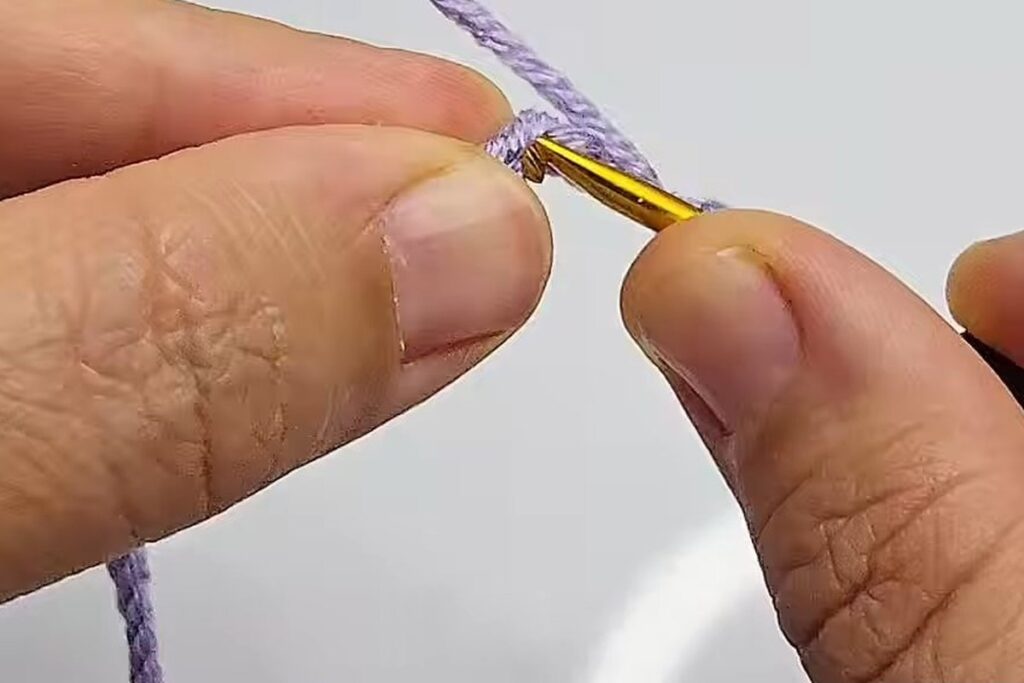
Step 1: Make a slip knot and chain 35
Make a slip knot on the 3.00 mm hook, then chain 35. Count them twice. Every later count in this crochet rose pattern depends on this number.


Step 2: Work 1 dc in the fifth chain from the hook
Count back five chains from the hook and work one double crochet there. The four chains you skipped stand in for a double crochet and a chain 1, so this first stitch already gives you a V-shape at the edge.
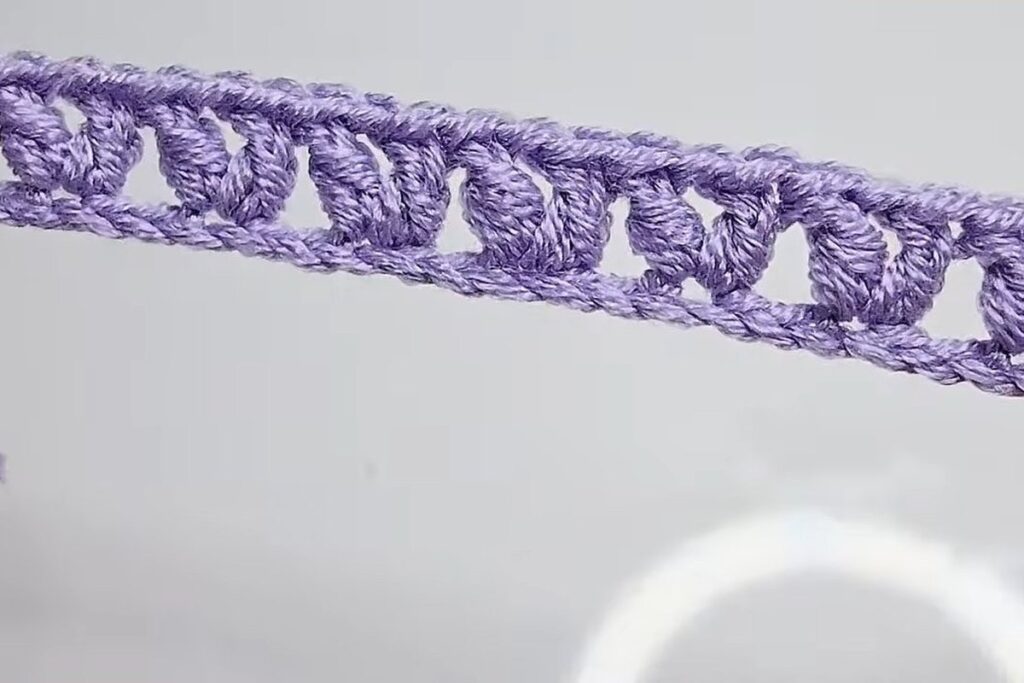
Step 3: V-stitch in every third chain
Skip two chains and work a V-stitch into the third: 1 dc, 1 ch, 1 dc, all in the same chain. Repeat to the end. You should have 11 chain-1 spaces along the strip, each one the seat for a petal.

Step 4: Turn and single crochet into the first space
Turn the work. Make one single crochet into the first V-stitch space to anchor the yarn at the start of the petal edge.

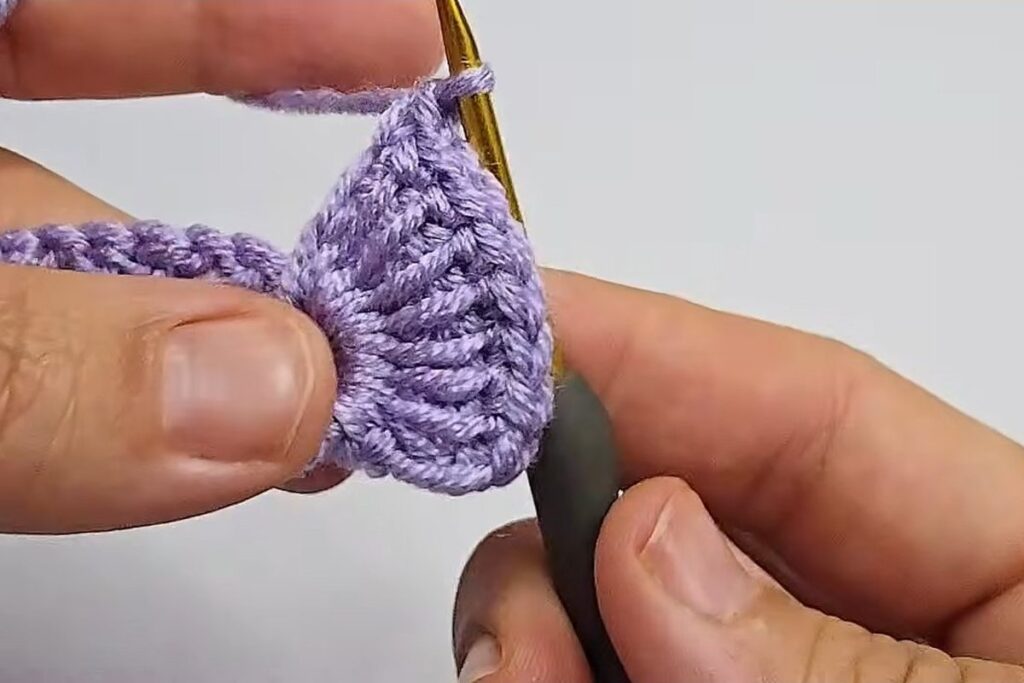
Step 5: Work 9 dc into the same space
Into that same space, work nine double crochet. The tutorial labels this “9 loops”. Keep them tight together so they fan out from the space rather than lying flat along the strip.


Step 6: Single crochet across the fan
Work single crochet across the top of the fan. The tutorial’s label for this pass reads “Sc/all”, one stitch into every stitch. This firms the curved edge and makes the petal cup slightly, which is what reads as a rose petal once it is rolled.
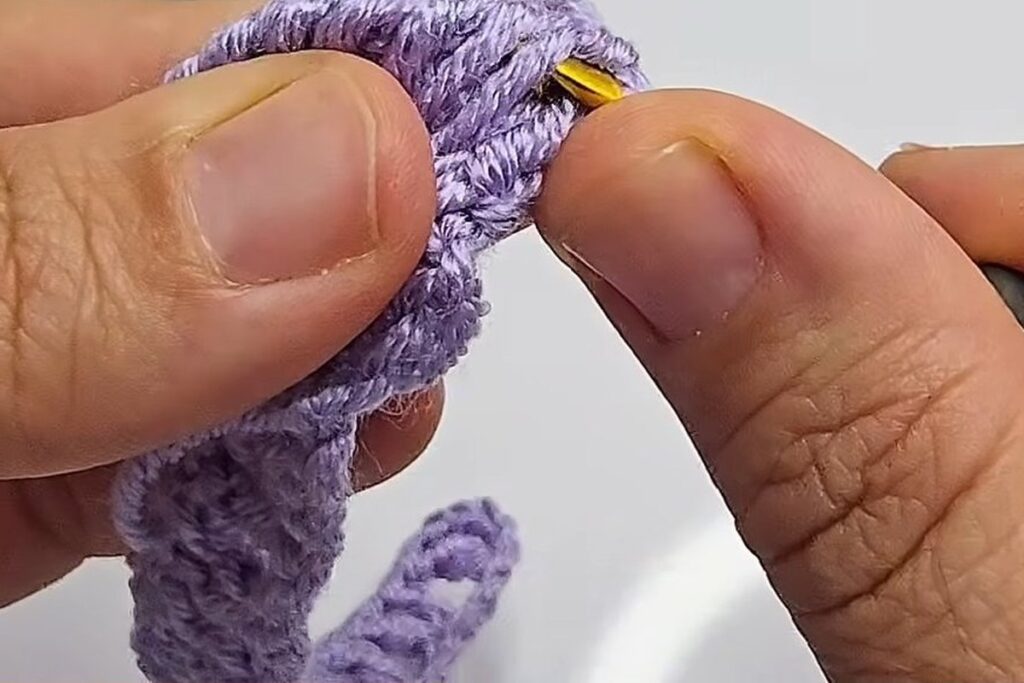
Step 7: Chain 3 and single crochet into the next space
Chain three, then single crochet into the next V-stitch space. The chain-3 bridges the gap between petals, so the fans sit side by side instead of pulling together.
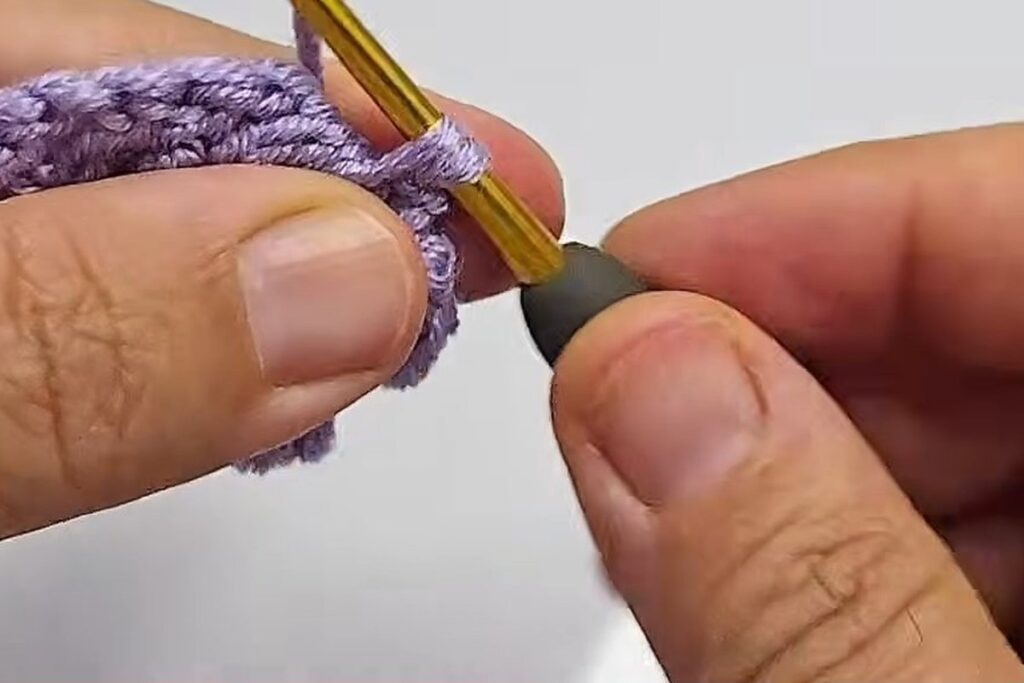
Step 8: Repeat the petal to the end of the strip
Repeat steps 5 to 7 in every space until you reach the end: 9 dc, sc across the fan, ch 3, sc into the next space. Fasten off and leave a tail long enough to weave in.

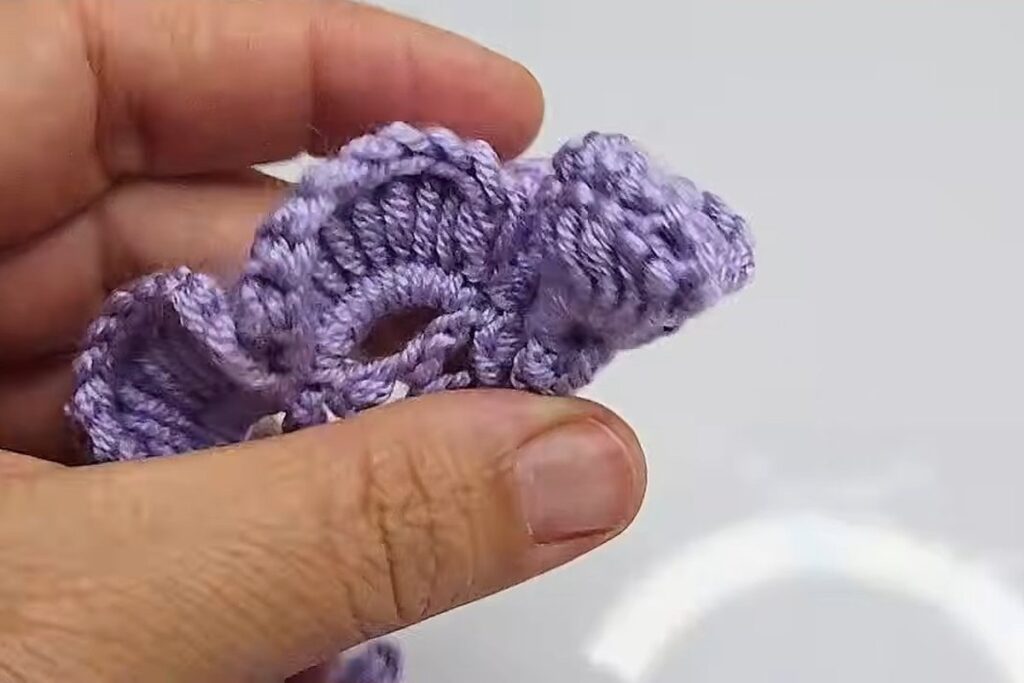
Make the six-point leaf
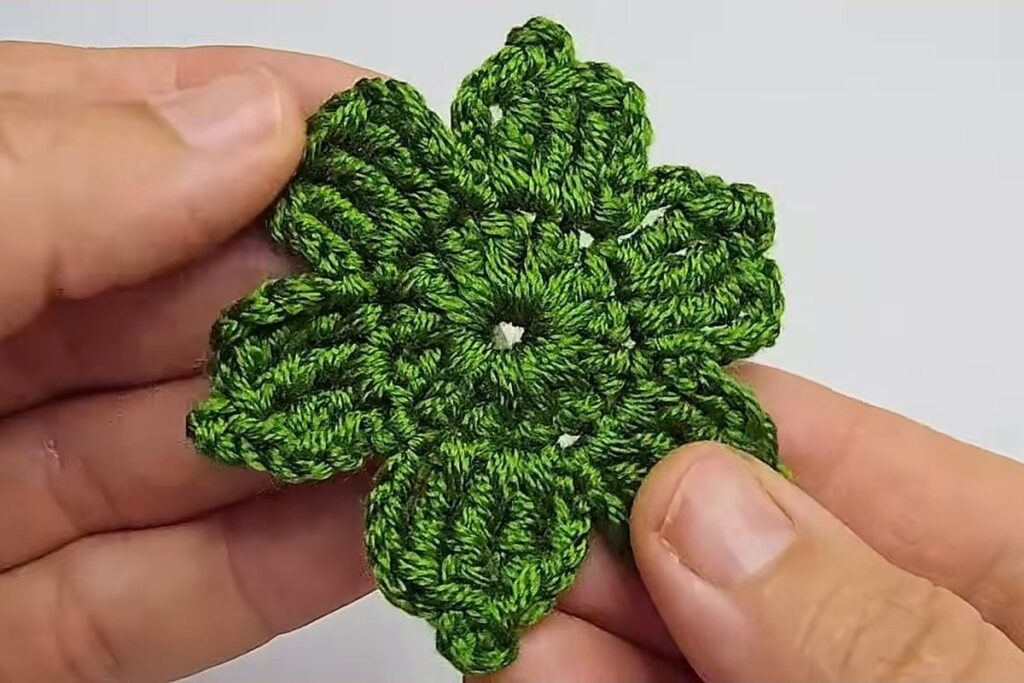
The leaf sits under the rose like a calyx and hides the glue, and it is the only part of the crochet rose pattern worked in the round. Switch to green yarn. It uses the same hook.
Step 9: Chain 5 and join into a ring
Chain five and slip stitch into the first chain to close a small ring.

Step 10: Work 12 dc into the ring
Chain three, then work double crochet into the ring until you have 12, as the on-screen label states. Join with a slip stitch. These 12 stitches are the base for the points.

Step 11: Start a leaf point with ch 4 and 2 tr
Chain four, then work two treble crochet. The tall trebles give the point its length.
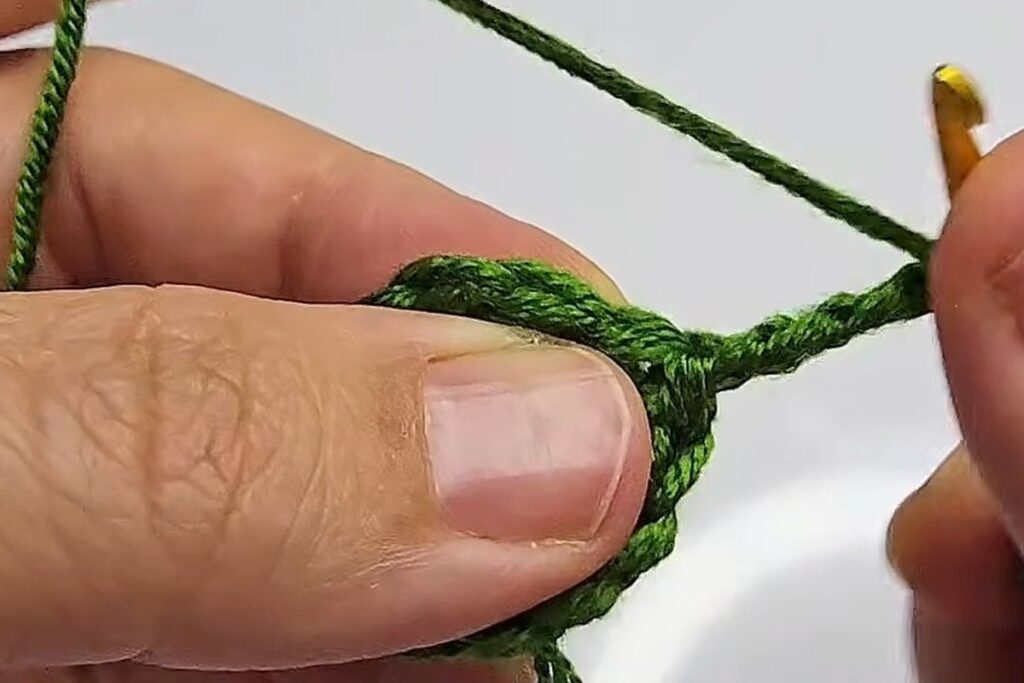
Step 12: Close the point, then repeat six times
The tutorial finishes each point in this order: ch 3, slip stitch to form the tip, 1 tr, ch 4, then a slip stitch back into the ring. Repeat round the ring. 12 stitches shared by six points is two ring stitches per point, so the points space out evenly without any counting on your part.
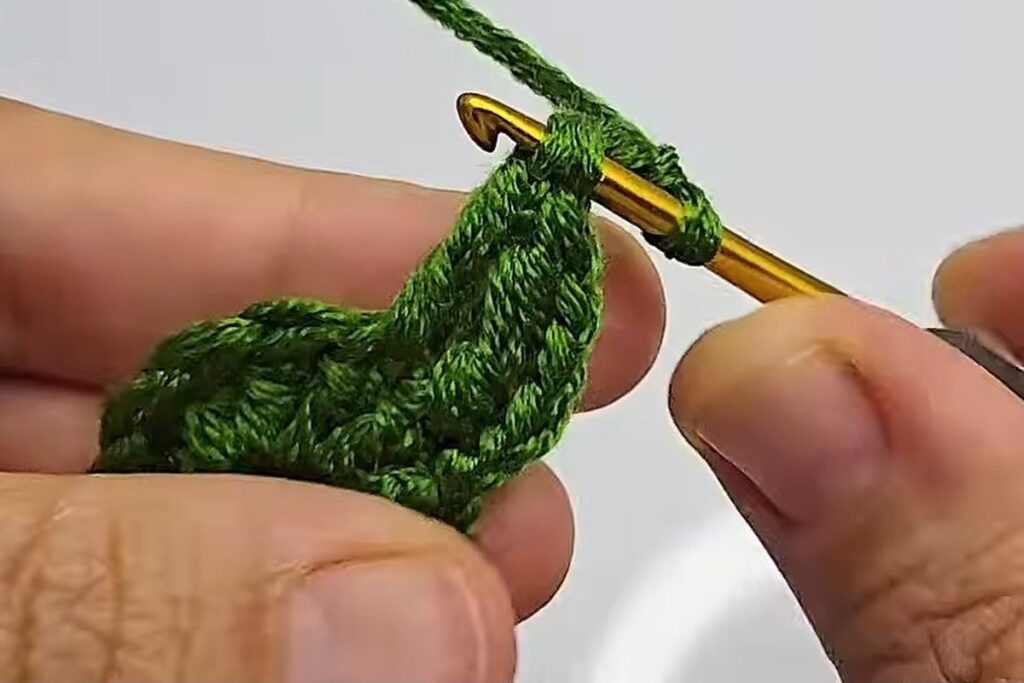
Roll and assemble the rose
This is where the flat strip of the crochet rose pattern turns into a flower. Warm up the glue gun before you start, and work over a mat. Hot glue burns, so keep your fingertips off the fresh bead and press with the yarn tail or a folded scrap.
Step 13: Roll the first petals and glue the centre
Start at the end where you fastened off. Roll the first petal tightly on itself to make the bud, and put a small dot of glue along the base of the strip as you go.


Step 14: Keep rolling, looser toward the outside
Carry on rolling, gluing the base every turn or two. Let each turn sit a little looser than the one before, so the outer petals open away from the centre. Glue down the starting tail at the back when you reach the end.

Step 15: Add the stem
Put a dot of glue on the end of the stem and push it into the base of the rose, into the tight centre of the roll. Hold it still until the glue sets.

Step 16: Slide on the leaf and glue it under the rose
Push the stem through the hole in the centre of the leaf ring and slide the leaf up under the flower. Glue it to the base of the rose so the points frame the petals.


Where this crochet rose pattern goes wrong
Three mistakes account for most roses that come out lopsided. All three are visible before you pick up the glue gun.
The last V-stitch misses the last chain. If the base count is off by one, the final V-stitch sits one chain short or has nowhere to go. The fix is the arithmetic above: 35 chains, first dc in the 5th, a V every 3rd, 11 spaces. Count the spaces before you start petals, not after.
The petals lie flat. Nine double crochet should crowd the space and push outward into a fan. If yours lie along the strip, the base chain is too loose for the fan, or you have worked the other convention’s double crochet, which is a single crochet here. Check the stitch table and try a tighter base chain.
The rose looks like a tube, not a flower. This comes from rolling too evenly. The centre wants to be tight, the outside loose. If every turn is wound the same, the petals stand straight up and nothing opens. Unroll, keep the first turns snug, and let the later ones flare.
Hook size and yarn for a crochet rose
The tutorial uses a 3.00 mm hook with acrylic yarn and does not state the yarn weight.
On the Craft Yarn Council yarn weight chart, 3.00 mm falls in the crochet hook range for category 1 (super fine) yarn, 2.25 to 3.5 mm. Category 2 (fine) runs 3.5 to 4.5 mm, category 3 (light) 4.5 to 5.5 mm and category 4 (medium) 5.5 to 6.5 mm. If your acrylic is heavier than super fine, a 3.00 mm hook gives dense petals, which suits a rose that has to hold its shape. Step up toward 3.5 mm if pushing the hook through gets hard.
The practical rule is to go down in hook size, not up. A crochet rose pattern needs firm fabric so the fans hold their curve, and a hook one size smaller than the ball band suggests gives that without making the stitches hard to work.
How much yarn does one rose use? This crochet rose pattern does not say, and there is no honest way to give a yardage without weighing a finished rose. What the stitch counts do tell you is the scale. The whole flower is one 35-chain strip with 11 petals of 9 double crochet, and the leaf is a single 12-stitch ring with six points. That is a small project, and oddments of lavender and green are enough for it.
If you want a real figure, weigh your ball before and after your first rose, then divide the remaining ball weight by that number to see how many roses it will make.
5 more free crochet rose patterns
These five free rose patterns come from independent designers, each with a different shape. Every figure is as stated on the designer’s page.
- Basic Rose by PlanetJune: the same rolled-strip idea as this one, in worsted weight yarn with a 4 mm hook, for a 2 inch rose, with an optional stem and calyx.
- Layered Rose Applique by Sweet Softies: three five-petal layers in one piece with no sewing, in light (3) yarn on a 3.75 mm hook, with 2.75 mm and 5 mm suggested for small and large roses.
- Lovely Long Stem Roses by The Loophole Fox: medium (4) yarn on a 5 mm hook, craft wire stems wrapped in yarn, and a rose about 10 inches tall.
- Free Rose Applique by Hookfully: a quick 2 by 2 inch scrap-yarn rose in DK on a 4 mm hook.
- Granny Square Rose by Wild+Wanderful: a rose motif from a magic ring, going from 4 petals to 8 across the rounds, in worsted weight on a 5 mm hook.
Where to go next
Once your first rose is on its stem, the same crochet rose pattern repeated a few times makes a bouquet. For more flowers on this site, try the free crochet flower pattern, the roundup of crochet flowers free pattern ideas, or the crochet sunflower pattern, which pairs well with a rose in a mixed vase.
Crochet rose pattern FAQ
Is this crochet rose pattern good for beginners?
Yes. It is one flat strip worked in rows, then rolled, so there are no rounds to join and no increases to track. You need to know chain, single crochet and double crochet. The leaf adds treble crochet.
What hook size does this crochet rose use?
The tutorial uses a 3.00 mm hook with acrylic yarn. A smaller hook makes firmer petals that hold their shape better once rolled.
How many chains do I start with?
35 chains. The first double crochet goes into the 5th chain from the hook, then a V-stitch into every 3rd chain, which gives 11 chain spaces for the petals.
Can I make the rose bigger?
Yes. Add chains to the base in multiples of 3 and you add one petal space for each 3 chains. A longer strip rolls into a fuller rose. The tutorial itself uses 35.
Do I have to use hot glue?
No. The tutorial uses a glue gun, but you can stitch the base of the roll together with a yarn needle as you roll. It takes longer and holds just as well.
How do I make the green leaf?
Chain 5 and join into a ring, then work 12 double crochet into it. Each of the six points is chain 4, 2 treble, chain 3, slip stitch, 1 treble, chain 4, then a slip stitch back into the ring.
Sources
- The step counts and on-screen labels come from a video tutorial, read frame by frame. The 11 spaces and the 2 stitches per leaf point are derived from those stated counts.
- Craft Yarn Council, Standard Yarn Weight System, crochet hook ranges for categories 1 to 4.
- PlanetJune, Basic Rose.
- Sweet Softies, Layered Rose Applique.
- The Loophole Fox, Lovely Long Stem Roses.
- Hookfully, Free Rose Applique Crochet Pattern.
- Wild+Wanderful, Granny Square Rose.